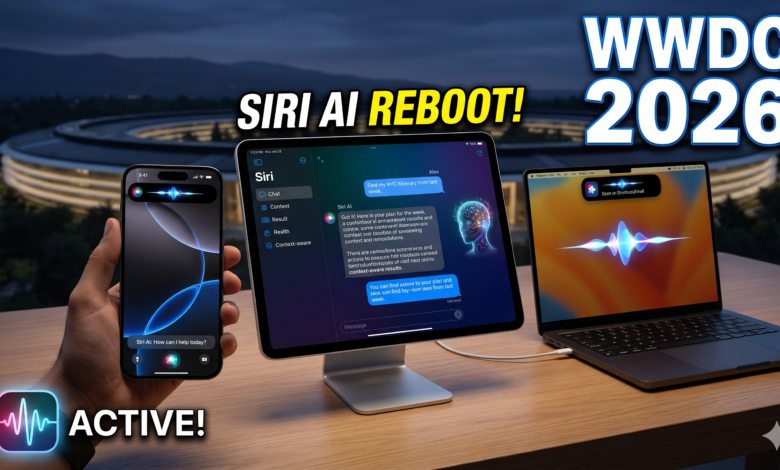
The tech industry witnessed a paradigm shift at Apple’s annual Worldwide Developers Conference (WWDC 2026), held from June 8 to June 12, 2026, at Apple Park. Operating under the tagline “All systems glow,” the event served as the ultimate stage for Apple’s transition into an agentic AI ecosystem. Faced with intense competition, Apple responded not just with minor iterative patches, but with a ground-up architectural rebuild of its core software platforms—introducing iOS 27, iPadOS 27, watchOS 27, visionOS 27, and macOS 27.
At the absolute center of this software transformation is Siri AI, a fundamentally overhauled version of Apple’s digital assistant designed to transition from a reactive voice tool into a proactive, system-wide autonomous companion.
Below is an exhaustive, deep-dive breakdown of the key capabilities, platform architectures, and performance paradigms introduced at WWDC 2026.
Lisen to Our podcast –
Talking Tech With AI – TTAi | WWDC 2026 Deep Dive
1. The “Frenemy” AI Architecture: Apple Intelligence Meets Google Gemini
For a company traditionally known for fierce corporate independence and end-to-end proprietary control, Apple’s headline architectural revelation was stunning: Siri AI heavily leverages Google’s Gemini technology under the hood.
Rather than building massive, resource-heavy large language models (LLMs) entirely from scratch, Apple pragmatically chose to white-label Google’s conversational family of models to close the generative AI gap instantly. However, Apple is executing this on its own strict terms. The local user interface, device-wide semantic parsing, and immediate multi-step routing are managed by next-generation Apple Foundation Models. When a request demands broad world knowledge or complex reasoning, it securely handshakes with Google’s model infrastructure. This hybrid framework represents a massive strategic pivot—allowing Apple to maintain ownership of the user interface and device ecosystem while exploiting external, state-of-the-art computational scale.
2. From Voice Assistant to System-Wide Proactive Agent
The core operational thesis of Siri AI is the transition from voice commands to agentic workflows. Siri is no longer isolated to a single launch overlay; it possesses cross-app context awareness and deep integration into the operating system.
- Personal Context Tracking: Siri can seamlessly cross-reference data across personal applications. For example, if a user asks, “Siri, what time does my sister’s flight land, and what did she want me to bring?” the assistant dynamically queries Mail or Messages for flight data, scans text history for contextual clues, and cross-references it with Calendar data to formulate a single cohesive answer.
- On-Screen Awareness: Levering new multimodal processing, Siri AI constantly understands what is currently happening on the user’s display. If a user is viewing a complex PDF document or an email thread, they can trigger Siri to execute follow-up actions like text summaries, translation, or generating calendar reminders based strictly on the visible on-screen elements.
3. The Death of Spotlight: Conversational, Ambient Search
Apple is systematically retiring the concept of keyword-dependent file hunting. At WWDC 2026, the company announced that it has completely rebuilt the structural foundations powering Spotlight, Photos, and Mail.
Traditional text-based query bars are being phased out by an ambient “Search or Ask” prompt integrated directly into the Dynamic Island. When a user activates Siri, a glowing cursor appears within the Dynamic Island, and results drop down in elegant, translucent cards. Pulling these cards downward expands the interaction into a dedicated, system-wide conversational search.
Instead of typing “Invoices June 2026,” users can speak contextually: “Find the contract document I was discussing with my manager via email late last month.” The underlying engine reads dates, parses conversational syntax in emails, recognizes identities, and Surfaces the exact file instantly.
4. Privacy-First Compute Foundations & Third-Party Auditing
To counter consumer anxiety regarding deep data scraping, Apple spent a significant portion of the keynote emphasizing its Private Cloud Compute architecture. Senior Vice President of Software Engineering, Craig Federighi, asserted that “privacy in AI is non-negotiable.”
“Data is only used to execute your request, and outside experts can continue to verify this promise at any time.”
— Craig Federighi, Apple SVP of Software Engineering
When Siri AI offloads complex tasks to the cloud, the data hits cryptographic, highly secure servers owned and managed by Apple. The platform operates on a data volatilization model: your personal data is utilized solely for the exact duration required to calculate the response and is never permanently written to storage, never shared with advertisers, and never used to build tracking profiles.
To build ultimate trust, Apple has opened this framework to independent third-party auditing. External cybersecurity firms and academic researchers are granted direct access to inspect the code and physical processes of Apple’s private cloud servers, creating a transparent verification ecosystem unique to consumer tech.
5. Natural Language as Code: The Shortcuts Revolution
Apple’s automation script tool, Shortcuts, received its most substantial update since its inception. Historically favored by power users due to its complex visual logic block setup, the app has been democratized via generative AI.
In iOS 27 and macOS 27, building automation requires zero technical knowledge. Users can simply prompt the application using plain text or voice commands.
The AI actively parses the conditional statements (“every Friday,” “starred emails,” “summary note”), maps them to the respective app APIs, and writes the background script automatically. This seamlessly expands powerful macros to older demographics or those with accessibility limits who cannot fiddle with visual node graphs.
6. The Camera as a Data Lens: “Visual Intelligence”
The native Camera app has been re-engineered from a tool that merely records memories into a multimodal data-gathering sensor. Apple introduced a permanent, dedicated Siri Mode directly alongside standard options like Photo, Video, and Panorama.
Replacing the previous hardware-bound Camera Control button mechanics, live Visual Intelligence acts in real-time as you frame an environment:
| Use Case | Camera Action | Visual Intelligence Outcome |
| Nutritional Tracking | Frame a plate of food | Identifies item (e.g., Pho) and overlays real-time macro-nutrient data. |
| Object Search | Frame an unlabelled product | Feeds item into Google Image Search to locate shopping or detail pages. |
| Contextual Travel | Aim camera at a historical landmark | Pulls historical timelines, booking availability, or hours of operation. |
7. Geopolitical & Regulatory Fragmentation (The EU Siri AI Delay)
A major point of discussion at WWDC 2026 was the direct impact of global antitrust legislation on feature deployment. Due to compliance challenges stemming from the European Union’s Digital Markets Act (DMA), Apple officially confirmed that Siri AI will be delayed in the EU for iOS 27 and iPadOS 27.
This creates a stark, unprecedented bifurcation of Apple’s flagship consumer experience:
- Global Ecosystem: Full rollout of cross-app Siri chatbots, visual intelligence, and Gemini integrations across iPhones and iPads.
- EU Ecosystem: iPhones and iPads will temporarily retain legacy search styles and limited local processing. Paradoxically, Mac, Apple Watch, and Apple Vision Pro users situated inside the EU will be allowed to access Siri AI, highlighting the intricate loopholes of device categories under the DMA framework.
8. The Dedicated Siri App & Chat Ephemerality
To directly compete with native applications from OpenAI and Anthropic, Siri AI is getting its own standalone application container.
The app features an iMessage-style interface with user-facing conversational threads and text bubbles. Within this dedicated UI, users can review an ongoing log of their past prompts, continue historical creative threads, or favorite critical search results.
Crucially, Apple is embedding chat ephemerality settings as a foundational privacy control. Users can configure their chat databases to automatically delete conversations after 30 days, one year, or preserve them indefinitely. History is synced end-to-end via iCloud across devices, but can be purged entirely at the touch of a button.
9. The Next-Gen App Store Economy: AI Agents
Apple dropped a highly compelling teaser regarding the future economics of third-party applications: a native integration framework for AI Agents inside the App Store.
While full execution documentation is slated for developer labs later in the year, this framework fundamentally alters how developers must compile apps. In the near future, developers will not only design user interfaces for human thumbs; they must expose semantic hooks and structured API parameters to the App Store’s underlying runtime. This will allow an elite AI agent—authorized by the user—to enter app environments autonomously to execute macro tasks such as booking third-party hotel reservations, editing files across separate cloud apps, or actively managing complex smart home parameters without the user ever opening the app manually.
10. Deep Universal Design: Accessibility Revolutionized by LLMs
Consistently a leader in digital accessibility, Apple leveraged its next-generation foundation models to solve extreme user-interface barriers for individuals with physical or cognitive challenges.
- VoiceOver Image Explorer: Utilizing localized vision models, this systemwide feature generates deep, hyper-detailed auditory descriptions of structural graphics, screen layouts, scanned financial records, bills, and handwritten personal documents.
- Natural Language Voice Control: Moving away from rigid, frustratingly specific dictation syntax, users no longer need to memorize exact system labels. If a user wants to select a button on screen, they can describe it in their own words (e.g., “Click that blue icon on the top corner”), and Siri AI infers the correct UI target element contextually.
- Real-time On-Device Captions: The OS will now generate automatic, completely offline captions for any piece of custom audio or personal video—whether recorded locally, received via text, or streamed from an uncaptioned web portal.
System Optimization: Baseline Performance Metrics
Lest developers worry that heavy AI features will cripple device responsive times, Apple showcased serious baseline kernel optimizations arriving with the 2026 software stack:
- Massive AirDrop Accel: AirDrop transfers see an 80% increase in speed due to fully optimized Wi-Fi and Bluetooth handshake protocols.
- Fluid UI Rendering: System-wide app launches and Photo Library rendering are up to 70% swifter under heavy memory loads.
- Unprecedented Backward Compatibility: Proving that its optimized small language models (SLMs) can scale down efficiently, Apple confirmed that iOS 27 will support all devices stretching back to the iPhone 11 series—making this one of the most widely accessible software rollouts in the company’s modern history.