Salt Water Desalination: Technologies, Impacts, and Strategic Importance in Modern Times
Introduction
Salt water desalination 6the process of removing salt and impurities from seawater to produce fresh water 6has become a critical technology in addressing global water scarcity. With roughly 97% of the Earth
9s water in oceans, which is saline, and only a small percentage available as fresh water, desalination provides an essential solution particularly for arid and water-stressed regions. This article delves into what desalination is, why it is needed, the key users and technologies, environmental and economic considerations, and concludes with real-world case studies highlighting its strategic importance in today
9s geopolitical context.
What is Salt Water Desalination and Why is it Required?
Desalination refers to the removal of dissolved salts and other minerals from seawater or brackish water to produce potable water suitable for human consumption, agriculture, and industry. The need for desalination arises primarily due to:
- Water Scarcity: Many regions experience chronic shortages of freshwater due to climatic conditions, population growth, and increased demand.
- Climate Change Impact: Altered precipitation patterns and droughts reduce reliable freshwater supplies.
- Limited Renewable Sources: Groundwater depletion and polluted surface waters necessitate alternative sources.
Countries with limited freshwater resources, such as those in the Middle East and North Africa, heavily rely on desalination to ensure water security. Additionally, as urbanization and industrialization escalate, the demand for reliable water sources intensifies globally.
Who Uses Desalination the Most?
The primary users of desalination can be grouped into:
- Wealthy Water-Scarce Nations: Gulf Cooperation Council (GCC) countries including Saudi Arabia, United Arab Emirates, Kuwait, Qatar, and Bahrain lead the world in desalination capacity, supplying the majority of their potable water through this method.
- Island States and Coastal Cities: Places like Singapore, Australia, and parts of California rely increasingly on desalination to supplement traditional freshwater.
- Developing Countries with Water Stress: Several countries in North Africa and South Asia are expanding desalination to meet growing demand but face challenges with costs and infrastructure.
Technical Processes in Desalination
Two predominant desalination technologies dominate the industry today: reverse osmosis and thermal distillation. Emerging methods offer promise for increased efficiency and reduced environmental impact.
Reverse Osmosis (RO)
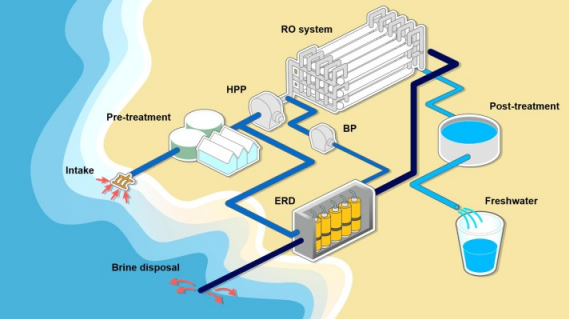
RO is a membrane-based process where seawater is forced through a semipermeable membrane that allows water molecules to pass but blocks salts and impurities. It is the most widely used desalination technology globally due to energy efficiency relative to thermal methods and scalability.
- Process: High pressure pumps increase seawater pressure to overcome osmotic pressure, driving freshwater through the membrane.
- Energy Use: RO plants consume around 3-4 kWh per cubic meter of produced water, with ongoing technological improvements driving reductions.
- Advantages: Lower energy consumption compared to thermal, compact plant footprint, modularity.
- Challenges: Membrane fouling, need for pre-treatment, brine disposal.
Thermal Distillation
This category includes multi-stage flash (MSF) distillation and multi-effect distillation (MED), which rely on heating seawater to evaporate water and leave salts behind.
- Multi-Stage Flash: Seawater is heated and flashed into steam in multiple stages at decreasing pressures. Condensed steam is collected as freshwater.
- Multi-Effect Distillation: Uses several evaporator stages where steam from one stage serves as the heat source for the next.
- Energy Use: Significantly higher than RO; MSF typically uses 10-16 kWh thermal per cubic meter.
- Advantages: Robust and proven technology, often cogenerated with power plants.
- Challenges: High energy consumption and greenhouse gas emissions unless supplemented by waste heat or renewable sources.
Emerging and Hybrid Technologies
New methods are being researched and piloted including forward osmosis, membrane distillation, electrodialysis, capacitive deionization, and solar desalination. Hybrid systems combining RO and thermal processes seek to optimize energy use and cost.
Environmental Impacts of Desalination
While desalination is instrumental in augmenting water supplies, it poses certain environmental challenges:
- Energy Consumption and Carbon Emissions: Many desalination plants depend on fossil fuels, contributing to greenhouse gas emissions.
- Brine Disposal: The concentrated salt brine byproduct, often twice as salty as seawater, when discharged back into oceans, can harm marine ecosystems by increasing salinity and altering local biodiversity.
- Chemical Use: Pre-treatment and cleaning processes use chemicals that may impact the environment if not managed properly.
Efforts to mitigate impacts include integrating renewable energy, improved brine management techniques such as dilution and beneficial use, and stringent environmental monitoring.
Economic Factors
Desalination projects require substantial capital investment, operational expenses, and upkeep. Key economic considerations include:
- Capital Costs: Construction of plants, intake and outfall infrastructure, pumping stations.
- Operational Costs: Energy is the largest ongoing cost, often accounting for 30-50% of expenses.
- Cost of Water Production: Typically, desalinated water costs from $0.50 to $3.00 per cubic meter depending on technology, scale, and energy prices.
- Subsidies and Financing: Many governments subsidize desalination to make water affordable.
- Economic Benefits: Secure water supplies reduce risks to agriculture, industry, and urban growth 6contributing to GDP stability and growth.
Global Usage and Policy Considerations
Globally, desalination capacity has grown steadily, particularly in the Middle East, North Africa, and parts of Asia-Pacific. Policy frameworks governing desalination include regulations on water quality, environmental impact assessments, and water pricing schemes.
Many countries incorporate desalination as part of integrated water resources management plans, with policies evolving to promote sustainability through renewable energy integration and water reuse.
Case Studies
Case Study 1: Gulf States 6 Saudi Arabia
Saudi Arabia is the world leader in desalination capacity, producing more than 5 million cubic meters of desalinated water daily, providing over 50% of its potable water. It primarily uses multi-stage flash and reverse osmosis technologies. The country integrates desalination plants with power production (co-generation) to enhance efficiency.
Data and Outcomes: Despite high costs, desalination supports urban centers like Riyadh and Jeddah, agricultural zones, and industrial sectors. Environmental initiatives include brine discharge diffusion systems and pilot solar-powered desalination plants.
Case Study 2: Gulf States 6 United Arab Emirates (UAE)
The UAE relies heavily on desalination for its water needs, with technologies primarily based on reverse osmosis and multi-effect distillation. Dubai
9s innovative initiatives include the Mohammed bin Rashid Al Maktoum Solar Park powering desalination plants.
Data and Outcomes: The UAE leads in exploring hybrid solar-RO plants, reducing carbon footprint while sustaining rapid population growth and industrial development.
Case Study 3: Poorer State 6 Gaza Strip, Palestine
In contrast, the Gaza Strip faces severe water scarcity exacerbated by political instability, infrastructure damage, and limited financial resources. Desalination plants exist but are small-scale and often donor-funded.
Data and Outcomes: Existing plants provide emergency freshwater but suffer from energy shortages and operational interruptions. Efforts focus on low-cost, solar-powered small desalination units but challenges remain concerning scale, sustainability, and political obstacles.
Case Study 4: Poorer State 6 Chennai, India
Chennai, a coastal metropolis with unpredictable monsoons and severe groundwater depletion, has invested in desalination to meet urban water demands, employing reverse osmosis plants commissioned at large scale.
Data and Outcomes: The plants face controversies regarding cost and environmental impact, but are critical during seasonal droughts. The government is integrating desalination with water conservation policies.
Strategic Importance of Desalination Plants in Current Conflict and War-like Situations
Water infrastructure, particularly desalination plants, has become critical national infrastructure in today
9s geopolitical environment marked by regional conflicts and security threats. Key aspects include:
- Essential for Human Survival: Many populations depend entirely on desalinated water. Disruptions lead to humanitarian crises.
- Targets for Sabotage or Attack: In conflict zones or tensions, such plants can be vulnerable to sabotage, cyberattacks, or physical damage.
- Military and Civilian Dependency: Armies and civilians alike require reliable water supplies; desalination plants support bases and urban centers.
- Resilience and Redundancy: Nations prioritize reinforcing desalination infrastructure with security measures, backup power, and diversified supply chains.
Potential Impacts of Desalination Plant Closure
If desalination plants shut down due to conflict, technical failure, or political instability, consequences can include:
- Severe Water Shortages: Populations reliant on desalinated water face immediate scarcity risking hygiene, health, and social unrest.
- Economic Disruption: Industries, agriculture, and power plants dependent on desalination face shutdowns or reduced productivity.
- Public Health Crises: Lack of clean water increases disease risks and mortality.
- Geopolitical Instability: Water scarcity can exacerbate tensions within and between nations.
Conclusion and Future Outlook
Salt water desalination is becoming indispensable in an era of growing freshwater scarcity, urbanization, and climate change. Advances in technology, integration with renewable energy, and innovative policy frameworks are making desalination more sustainable and cost-effective.
However, the environmental footprint and high energy demands require continuous innovation and regulation to ensure desalination
9s role supports long-term global water security. Additionally, the strategic significance of desalination plants amid geopolitical tensions underscores the need for resilience and protection of this critical infrastructure.
Investment in emerging technologies, improved brine management, and international collaboration will shape the future of desalination as a cornerstone of sustainable water resources worldwide.
Sources
- https://www.awwa.org/resources-tools/water-knowledge/desalination
- https://www.iea.org/reports/desalination
- https://www.worldbank.org/en/topic/waterresourcesmanagement/brief/desalination
- https://www.gcc-sg.com/desalination-technology/
- https://www.unwater.org/water-facts/scarcity/
- https://www.mdpi.com/2073-4441/11/12/2553
- https://www.researchgate.net/publication/327064786_Environmental_Impact_Assessment_of_Desalination_Plants_in_the_Middle_East
- https://www.sciencedirect.com/science/article/pii/S0048969719342135
- https://www.nature.com/articles/s41545-019-0033-z
- https://www.wri.org/insights/desalination-future-water-scarcity