Salt Water Desalination: Technology & Strategic Importance

Introduction
Salt water desalination — the process of removing salt and impurities from seawater to produce fresh water — has become a critical technology in addressing global water scarcity. With roughly 97% of the Earth’s water held in saline oceans and only a small percentage available as fresh water, desalination provides an essential solution, particularly for arid and water-stressed regions. This article delves into what desalination is, why it is needed, the key technologies involved, and its strategic importance in today’s geopolitical context.
What is Salt Water Desalination and Why is it Required?
Desalination refers to the removal of dissolved salts and other minerals from seawater or brackish water to produce potable water suitable for human consumption, agriculture, and industry. The need for desalination arises primarily due to several pressing factors:
- Water Scarcity: Many regions experience chronic shortages of freshwater due to climatic conditions and rapid population growth.
- Climate Change: Altered precipitation patterns and prolonged droughts are reducing the reliability of traditional freshwater supplies.
- Limited Renewable Sources: Groundwater depletion and polluted surface waters necessitate the development of alternative sources.
Countries with limited freshwater resources, such as those in the Middle East and North Africa, heavily rely on desalination to ensure national water security.
Who Uses Desalination the Most?
The primary users of desalination technology can be categorized into three main groups:
- Wealthy Water-Scarce Nations: Gulf Cooperation Council (GCC) countries, including Saudi Arabia and the UAE, lead the world in capacity, supplying the majority of their potable water via this method.
- Island States and Coastal Cities: Singapore, Australia, and coastal California rely on desalination to supplement traditional reservoirs.
- Developing Countries: Several nations in North Africa and South Asia are expanding infrastructure to meet growing industrial demand.
Technical Processes in Desalination
Two predominant technologies dominate the industry today: Reverse Osmosis and Thermal Distillation.
Reverse Osmosis (RO)
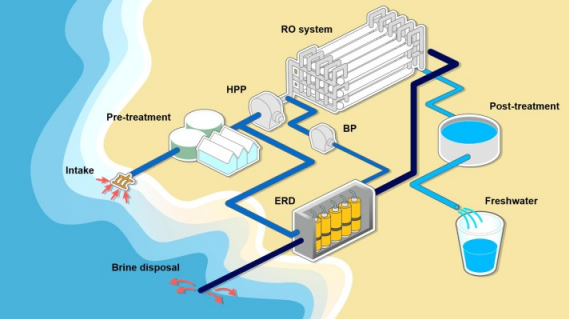
RO is a membrane-based process where seawater is forced through a semipermeable membrane that blocks salts and impurities. It is currently the most widely used technology globally due to its scalability and relative energy efficiency.
- Energy Use: RO plants typically consume 3-4 kWh per cubic meter of water produced.
- Advantages: Lower energy consumption compared to thermal methods, a compact footprint, and high modularity.
- Challenges: Issues include membrane fouling and the environmental impact of brine disposal.
Thermal Distillation
This category includes processes like Multi-Stage Flash (MSF) and Multi-Effect Distillation (MED), which rely on heating seawater to separate freshwater through evaporation.
- Multi-Stage Flash (MSF): Seawater is heated and flashed into steam across multiple stages at decreasing pressures.
- Energy Use: Significantly higher than RO; MSF typically requires 10-16 kWh thermal per cubic meter.
- Advantages: Robust, proven technology that is often co-generated with power plants to utilize waste heat.
Environmental and Economic Considerations
While desalination is vital, it poses environmental challenges such as high carbon emissions and the disposal of concentrated brine, which can harm marine ecosystems. Furthermore, the economic costs are substantial. Energy often accounts for 30-50% of operational expenses, with water production costs ranging from $0.50 to $3.00 per cubic meter depending on technology and scale.
Strategic Importance and Geopolitical Security
In modern times, desalination plants are considered critical national infrastructure. Because many populations depend entirely on these facilities for survival, they are increasingly viewed through the lens of national security:
- Humanitarian Resilience: Disruptions to these plants can lead to immediate health crises.
- Targets for Conflict: These facilities are vulnerable to physical sabotage and cyberattacks in volatile regions.
- Economic Stability: Secure water supplies are essential for maintaining GDP growth and industrial productivity.
Conclusion
Salt water desalination is an indispensable tool in the era of climate change and urbanization. As technology advances—particularly through integration with renewable energy—desalination will become more sustainable. However, the high energy demands and strategic vulnerabilities of these plants require ongoing innovation and international cooperation to ensure long-term global water security.